
UMD College of Behavorial & Social Sciences UMD College of Behavorial & Social Sciences
MENU

Topbar Menu

  • About Us
  • People
  • Undergraduate
    • Prospective Students
      • Why Major In Anthropology At UMD?
      • Why Major In Anthropology At UMD?
      • What do UMD Anthropology Majors do?
      • What do UMD Anthropology Graduates do?
      • How to become an Anthropology Major?
    • Current Students
      • Advising
      • Academic Opportunities
      • Internships and Career Development
      • Community and Support
  • Graduate
    • Graduate Studies
    • Graduate Studies
    • PhD Program
    • MAA Program
    • MPS CHRM
    • MAA/MHP Dual Degree
    • Certificate Programs
    • Graduate Student Resources
    • Funding Options
  • Research
    • Health
    • Health
    • Heritage
    • Environment
    • Genetics & Evolution
Search

Main navigation

  • Undergraduate
    • Prospective Students
      • Why Major In Anthropology At UMD?
      • What do UMD Anthropology Majors do?
      • What do UMD Anthropology Graduates do?
      • How to become an Anthropology Major?
    • Current Students
      • Advising
      • Academic Opportunities
      • Internships and Career Development
      • Community and Support
  • Graduate
    • Graduate Studies
    • PhD Program
    • MAA Program
    • MPS CHRM
    • MAA/MHP Dual Degree
    • Certificate Programs
    • Funding Options
    • Graduate Student Resources
  • Research
    • Health
    • Heritage
    • Environment
    • Genetics & Evolution
  • About Us
  • Diversity and Inclusion
  • People

Search our site:

The Archaeology of Ireland’s Early Modern Period: The Formation and Transformation of Irish identities and the Irish Diaspora
Breadcrumb

  • Home
  • Featured Content
  • The Archaeology of Ireland’s Early Modern Period: The Formation and Transformation of Irish Identities and The Irish Diaspora
UMD ANTH

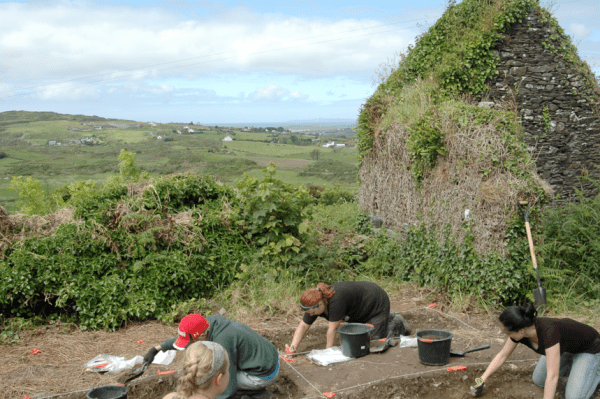
This summer, Dr. Stephen Brighton, associate professor of anthropology and director of The Archaeology of Ireland’s Early Modern Period, led a group of UMD students into the second field season in Skibbereen, County Cork, Ireland.

Skibbereen is located 51 miles (82 km) southeast of Cork City. It became infamous as a metaphor for the impacts and horrific sufferings of the Great Starvation. In the summer of 2015 the excavations focused on six cabins located on the heights above the town of Skibbereen.

This summer, the students are just outside of Skibbereen and in the beautiful Lough Hyne region along the southwestern coast of County Cork. The aim of the 2016 excavations is to investigate the remains of a 19th-century multiple-room cabin standing above ground dating to the pre-Famine period, and inhabited until the turn of the 20th century, as well as the investigation for traces of up to six single-room pre-Famine cabins abandoned by 1850.

The excavations and recovered materials will be an important part of Dr. Brighton’s on-going research into both the local and larger national political economic and socio-cultural transformations over time. The new insights gained from the work of UMD students are critical for the interpretation of material culture and the formation and transformation of Irish identities. The project data is also allowing for a transnational study of the Irish Diaspora and forms the foundation for a comparable database to model and interpret the diverse worlds and experiences of Irish immigrants internationally. 

For more information, visit: http://globalmaryland.umd.edu/offices/education-abroad/program/11224

Published on Mon, 06/27/2016 - 11:27

College of Behavioral & Social Sciences

Department of Anthropology

1111 Woods Hall
4302 Chapel Ln
College Park, MD 20742

Phone: 301-405-1423 
Fax: 301-314-8305

Email: @email 

Links
  • UMD Land Acknowledgement
  • UMD Staff Directory
  • UMD Web Accessibility
  • Alumni
© 2026 College of Behavioral & Social Sciences. All Rights Reserved.
Login