
UMD College of Behavorial & Social Sciences UMD College of Behavorial & Social Sciences
MENU

Topbar Menu

  • About Us
  • People
  • Undergraduate
    • Prospective Students
      • Why Major In Anthropology At UMD?
      • Why Major In Anthropology At UMD?
      • What do UMD Anthropology Majors do?
      • What do UMD Anthropology Graduates do?
      • How to become an Anthropology Major?
    • Current Students
      • Advising
      • Academic Opportunities
      • Internships and Career Development
      • Community and Support
  • Graduate
    • Graduate Studies
    • Graduate Studies
    • PhD Program
    • MAA Program
    • MPS CHRM
    • MAA/MHP Dual Degree
    • Certificate Programs
    • Graduate Student Resources
    • Funding Options
  • Research
    • Health
    • Heritage
    • Environment
    • Genetics & Evolution
    • Laboratories
Search

Main navigation

  • Undergraduate
    • Prospective Students
      • Why Major In Anthropology At UMD?
      • What do UMD Anthropology Majors do?
      • What do UMD Anthropology Graduates do?
      • How to become an Anthropology Major?
    • Current Students
      • Advising
      • Academic Opportunities
      • Internships and Career Development
      • Community and Support
  • Graduate
    • Graduate Studies
    • PhD Program
    • MAA Program
    • MPS CHRM
    • MAA/MHP Dual Degree
    • Certificate Programs
    • Funding Options
    • Graduate Student Resources
  • Research
    • Health
    • Heritage
    • Environment
    • Genetics & Evolution
    • Laboratories
  • About Us
  • Diversity and Inclusion
  • People

Search our site:

Understanding how people value the benefits oysters provide to find common ground for Long Island oyster management
Breadcrumb

  • Home
  • Featured Content
  • Understanding How People Value The Benefits Oysters Provide To Find Common Ground For Long Island Oyster Management
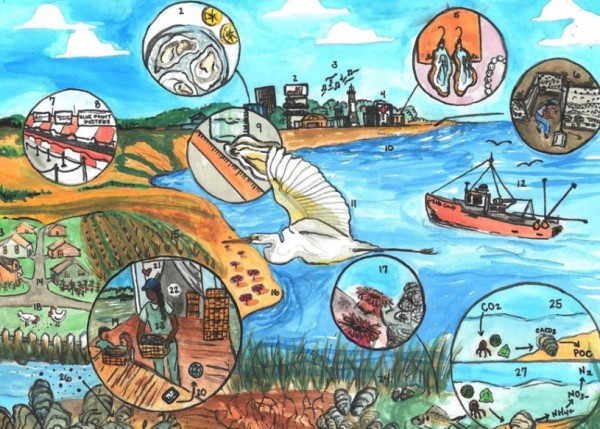
Graphic of Long Island Oyster Market and Systems

Coastal areas are places of deep ecological, economic, and cultural importance, but they are also places where many different people want different things from the same stretch of water and shoreline. On Long Island, oysters sit at the center of these tensions. They can help clean water, support jobs and local food, and contribute to restoration and climate resilience. At the same time, oysters and oyster farming can raise difficult questions about access, use, aesthetics, and management.

In this study, we worked with a wide range of people connected to oysters on Long Island, including yacht clubs, town representatives, environmental organizations, oyster farmers, artists, researchers, and others. We wanted to understand both where people disagreed and where they might share common ground. To do this, we used two approaches together. First, in small-group workshops, participants created maps showing the oyster-related benefits and concerns they found most important and how they believed these were connected. Second, participants took photographs and shared stories about what oysters and coastal places meant in their lives.

Using both approaches together helped us see not only what people valued, but also why those values mattered to them. We found that participants often differed in how they thought positive change should happen. For example, they did not always agree on the best way to improve coastal conditions. Even so, many groups shared important concerns and goals. Clean water, working waterfronts, and the future of coastal communities appeared repeatedly across the study.

Our findings suggest that conflict around oysters is not only about opposition. It is also about different experiences, relationships, and ideas about how to achieve similar goals. That matters for management. If decision-makers begin with the values people already share, they may be better able to build policies and partnerships that support collaboration, local buy-in, and more sustainable coastal futures.

Read More Here: Plain language summary | Understanding how people value the benefits oysters provide to find common ground for Long Island oyster management – Relational Thinking

Published on Mon, 11/23/2026 - 11:20

College of Behavioral & Social Sciences

Department of Anthropology

1111 Woods Hall
4302 Chapel Ln
College Park, MD 20742

Phone: 301-405-1423 
Fax: 301-314-8305

Email: @email 

Links
  • UMD Land Acknowledgement
  • Give to ANTH
  • UMD Staff Directory
  • UMD Web Accessibility
  • Alumni
© 2026 College of Behavioral & Social Sciences. All Rights Reserved.
Login